We set out to answer a deceptively simple question: if you want to play with AI and robotics today, which open source robotic arm should you actually build?
So we did what we always do at LTC Labs: we ran a deep research pass, fanned out across primary sources, and let an adversarial verifier try to tear down every claim. What survived is below.
The framework runs the show, not the arm
The first lesson flips the question on its head. In 2025 and 2026 the whole low-cost robotics scene is organised around one piece of software: LeRobot, Hugging Face's open source library (Apache-2.0, PyTorch). It is not an arm. It is the common layer of drivers, datasets, models and training tools that every serious project now plugs into.
LeRobot natively supports a whole catalogue: the low-cost SO-100 and SO-101, the Koch v1.1, the bimanual ALOHA-2, mobile manipulators like Stretch-3 and LeKiwi, and humanoid arms like Hope-JR and Reachy-2. Recent releases even add the Unitree G1.
The shared mechanism is leader-follower teleoperation. LeRobot reads the joint positions of a leader arm and writes them onto a follower. That same loop records expert demonstrations for imitation learning, and then runs the learned policy straight back on the follower. So the practical takeaway is blunt: the arm matters less than whether it is integrated in LeRobot. If it is, the driver, the dataset format and the training pipeline are already solved for you.
The entry tier: where most people should start
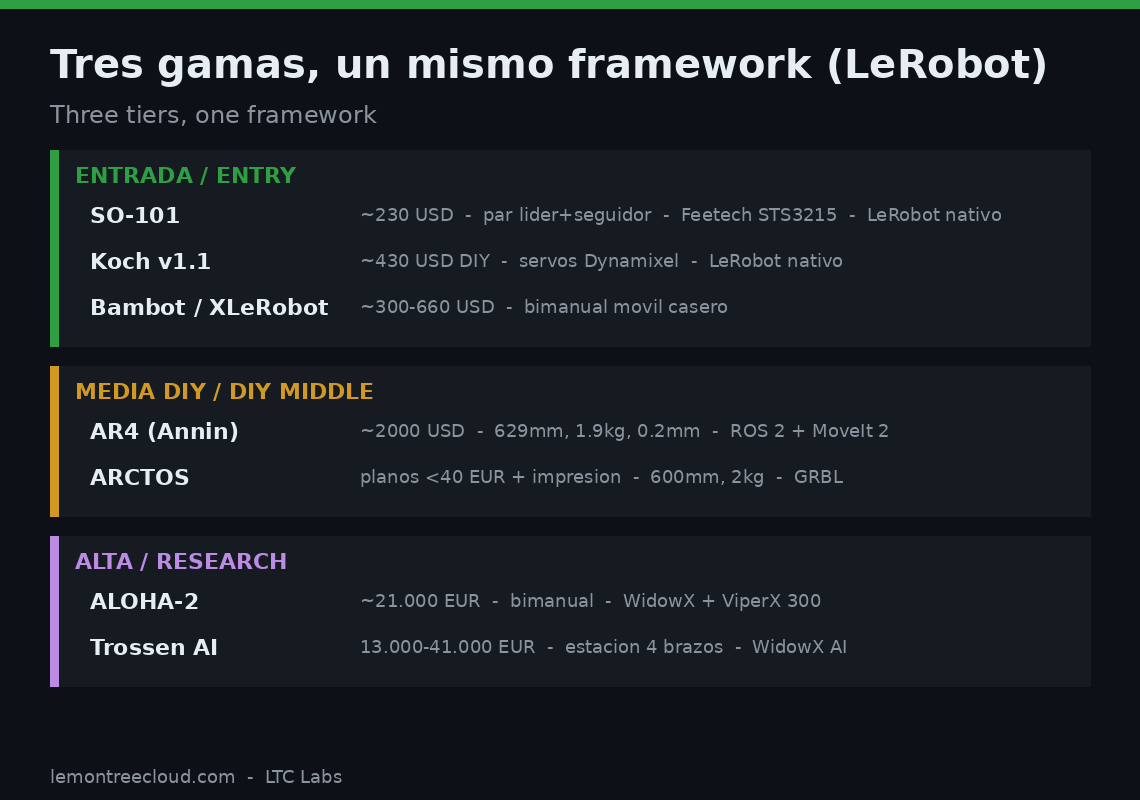
The SO-101 is the de facto star of the ecosystem. Each arm uses six Feetech STS3215 bus servos, the structure is 3D printed, and a full leader-plus-follower pair costs around 230 dollars. It is sold ready-to-build by Seeed Studio, Hiwonder, ThinkRobotics and others, and the design lives openly on GitHub. For getting into LeRobot today, nothing beats its price-to-community ratio.
The Koch v1.1 is the step up. Instead of Feetech servos it uses Dynamixel motors, which cost more but give you better control. A DIY build runs about 430 dollars; the commercial ROBOTIS kit is pricier. Pick the SO-101 if budget rules, the Koch if you want premium actuation.
And if you want a bimanual mobile setup on a shoestring, Bambot is essentially two SO-100 arms on a LeKiwi base, propped up with bamboo, for roughly 300 dollars. Its cousin XLeRobot pushes a dual-arm home robot to about 660 dollars.
The DIY middle: more reach, more payload
The AR4 from Annin Robotics is the most industrial of the accessible builds. The MK3 gives you a 629 mm reach, around 1.9 kg of payload and 0.2 mm repeatability, driven by NEMA stepper motors on an aluminium frame. It is not native to LeRobot, but it ships a mature ROS 2 driver with MoveIt 2, which makes it a better fit for precise pick-and-place than for pure imitation learning.
ARCTOS is the printable 6-DOF you build for fun: roughly 600 mm reach, 2 kg payload, NEMA steppers and GRBL-based firmware. The firmware is open, the hardware plans are a small paid download, and it has a 4,000-strong Discord community. Great for learning the mechanics, not a precision instrument.
The research high end
ALOHA and its successors are the standard for serious bimanual research, the hardware behind the ACT and Mobile ALOHA papers. A stationary ALOHA-2 setup, built from Trossen's WidowX and ViperX 300 arms, lands around 21,000 euros; Mobile ALOHA, with its mobile base, closer to 32,000 dollars. In 2025 and 2026 the line has been rebranded as Trossen AI, with the all-metal WidowX AI as its flagship and turnkey four-arm data-collection stations selling between roughly 13,000 and 41,000 euros. This only makes sense with a lab budget.
So what would we build?
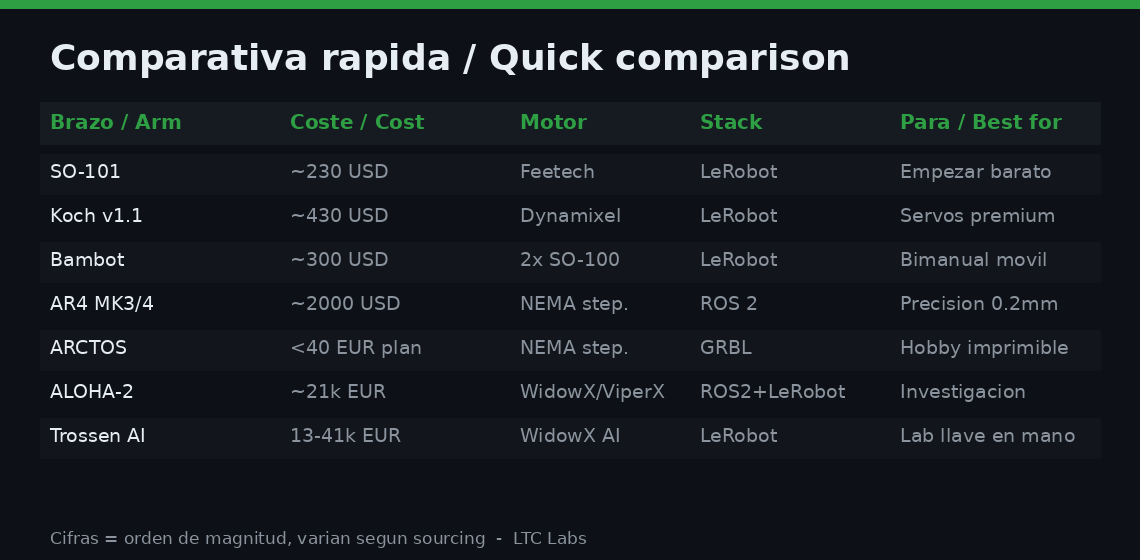
For learning AI and teleoperation, the SO-101 is the obvious entry point: about 230 dollars for the leader-follower pair, native LeRobot integration, the largest community, trivial spare parts and printable structure. Step up to the Koch v1.1 if you want better servos and don't mind paying for them. Reach for AR4 if your goal is precise ROS 2 pick-and-place rather than imitation learning. And the jump to ALOHA or Trossen only pays off when you have a research budget and a genuine need for two arms.
A word on method
This post is the readable end of a noisier process. The verified core, that LeRobot is the hub, that leader-follower teleoperation is the shared mechanism, and the rough cost bands, all passed a three-vote adversarial check against the primary LeRobot paper. The finer specs and unit prices came from targeted follow-up searches, so treat every figure as an order of magnitude, not a quote. Prices swing with sourcing: DIY versus a commercial kit can differ by half, as the Koch's 430-dollar build versus its 670-euro kit shows.
Sources and links
- LeRobot - GitHub (Hugging Face)
- LeRobot - official docs
- LeRobot - paper (arXiv)
- SO-ARM100 / SO-101 - GitHub (TheRobotStudio)
- SO-101 - LeRobot docs
- Koch v1.1 - GitHub (jess-moss)
- Bambot - GitHub (timqian)
- XLeRobot - GitHub
- AR4 - Annin Robotics
- AR4 - ROS 2 driver (Ekumen-OS)
- ARCTOS - arctosrobotics.com
- ALOHA-2 - paper (arXiv)
- Mobile ALOHA - paper (arXiv)
- Trossen AI - trossenrobotics.com
- LeRobotDepot - community catalog
Want the full breakdown? Download the complete report, with the per-arm detail and every source.
Report in English (.md) | Informe en espanol (.md)
This is LTC Labs: we research in the open and we show our work.