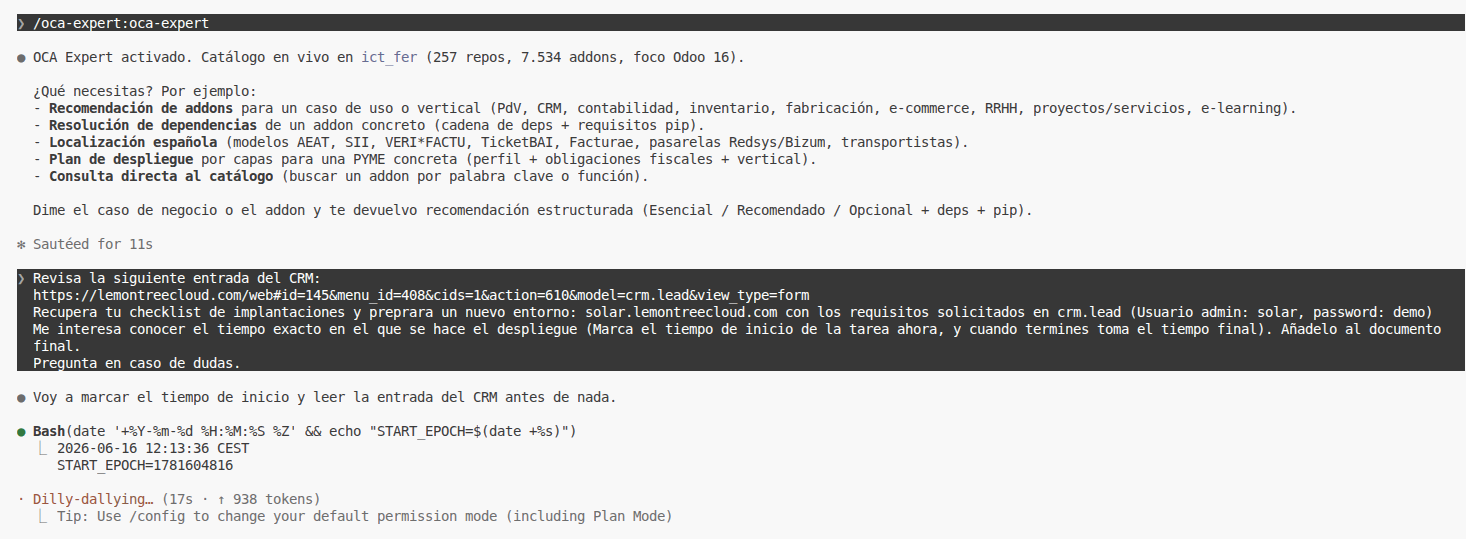
A phone rings at Lemon Tree Cloud. Forty minutes later there is a working Odoo quality-management system on the internet. Here is how that happens.
This is the story of a single morning: an inbound call answered by our virtual assistant, a qualified opportunity in the CRM, and a full demo environment - DNS, container, Odoo, modules and SSL - deployed and verified in 24 minutes and 47 seconds.
MarIA answers the phone
MarIA is our virtual voice assistant. She picks up calls around the clock, introduces herself, and tells the caller the call is recorded. Then she does what a good pre-sales person does: she listens, asks the right questions, and qualifies the need in business or technical terms, whatever the caller prefers.
While she talks, three things happen automatically behind the scenes. The call is recorded. Every turn is transcribed in real time. And when the call ends, MarIA writes a summary and creates an opportunity in our Odoo CRM, with the full transcript posted in the chatter and the audio recording attached.
Nobody types anything. By the time Fernando opens the CRM, the lead is already there: who called, what they need, the estimated budget and timeline, and a word-for-word transcript to review.
📄 Download the anonymized call transcript (PDF)
From a call to a qualified opportunity
In this case the caller was a quality manager at a renewable-energy company - solar, wind and hydro - operating across Europe. They wanted a single system to manage quality across the whole lifecycle: engineering, construction and operation. Non-conformities, corrective actions, audits, and reports that prove regulatory compliance.
The numbers MarIA captured: 84 users, an in-house IT team, no existing software for this, on-premise servers, and three simultaneous sites. She framed a realistic project (Odoo on the client's own servers, 15,000 to 35,000 euros, two to three months) and offered a written proposal from Fernando. All of it landed in the CRM as a structured opportunity.
How we build an Odoo environment at Lemon Tree Cloud
To support a proposal, a demo beats a slide deck. So we built one. Our deployments follow a repeatable pattern, the same one behind every Lemon Tree Cloud instance.
First we pick the modules. We keep a live catalogue of the whole OCA ecosystem - thousands of community addons - and select the ones that fit the use case. For a quality-management system that meant the OCA management-system suite (quality manual, non-conformities, corrective actions, audits), the document and knowledge modules for compliance documentation, and project management for the engineering-construction-operation lifecycle.
Then we deploy. A new isolated container on our Proxmox host, a two-container Docker stack (Odoo plus PostgreSQL), the addons pulled straight from the community repositories, and a reverse proxy with an automatic Let's Encrypt certificate. DNS, container, database, modules and SSL: each step scripted, each step verified.
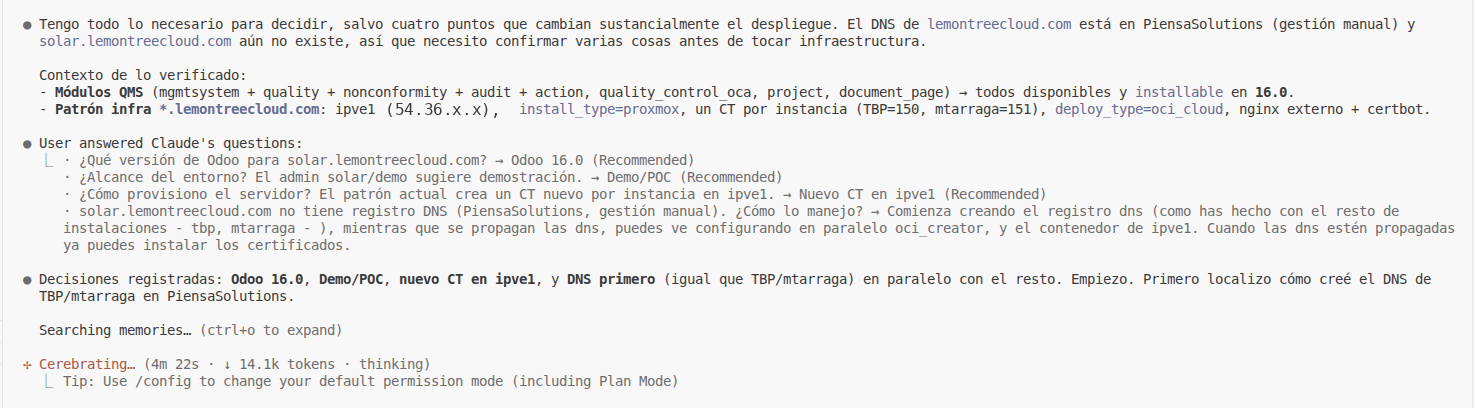
Before touching anything we confirm the decisions that actually change the build: Odoo version, scope, where the server lives, and how DNS is handled. Everything else is automation.
Solar Demo: a full deployment in under an hour
With the decisions made, the clock started. The DNS record went in first so it could propagate while the rest was built in parallel. A fresh container came up on the Proxmox host. Docker, the Odoo 16 image and PostgreSQL were installed. The four community repositories were cloned and sixteen quality modules were installed into a clean database. Nginx and a Let's Encrypt certificate were issued once DNS had propagated. Finally, the login, the certificate and every module were verified.
Total wall-clock time, including the conversation to confirm requirements and the wait for DNS to propagate: 24 minutes and 47 seconds. The result is live - a clean Odoo 16 with the full quality-management suite, ready to show the client.

📄 Download the full deployment report (PDF) - IP addresses partially masked for security.
Why this matters
The point is not that one deployment was fast. The point is that the whole chain - a call answered, a need qualified, a record created, an environment built - runs on the same stack we sell. MarIA is Odoo. The CRM is Odoo. The demo is Odoo, deployed the way we deploy production. When we tell a client we can have them running in weeks, this is the evidence.